
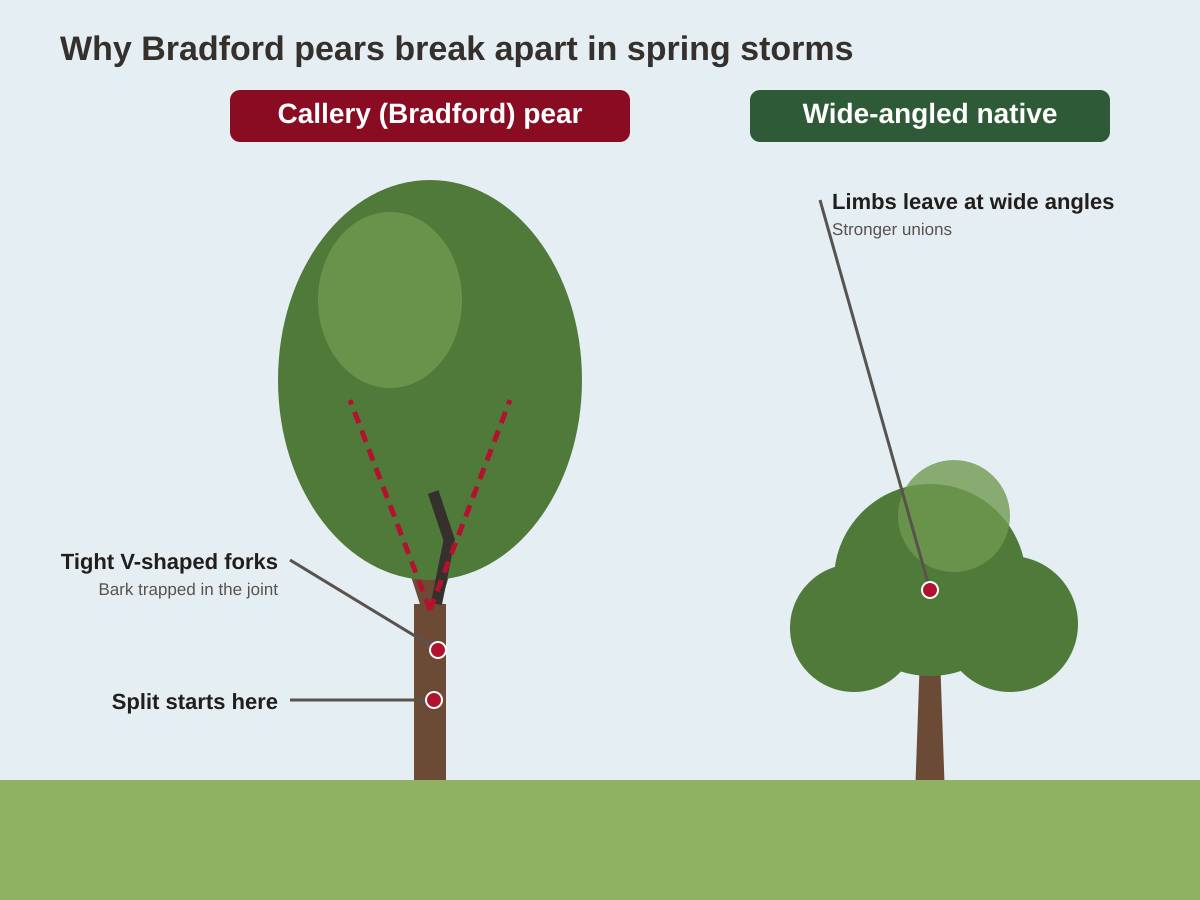
A tree built to break
The Bradford pear is a cultivar of the Callery pear, a tree from East Asia. It was promoted for decades as the perfect street tree: fast, tidy, tolerant of poor soil and covered in white blossoms. The problem is how it grows. Instead of one central trunk with side branches spaced up the stem, a Bradford sends up many upright branches from nearly the same point. As those branches thicken, bark gets trapped in the narrow angle between them, so the wood never properly knits together.
While the tree is young, that hardly matters. As it matures, each stem gets heavy enough that wind, a load of wet snow or a coat of ice can pry the weak joint apart. When one stem goes, it often tears a long strip of trunk with it, leaving the rest of the tree lopsided and even more likely to fail.
Why it's also an ecological problem
Bradford pears were sold as sterile, and a single Bradford planted alone usually sets little fruit. But once other Callery pear varieties were planted nearby, they began cross-pollinating. Birds eat the small fruit and drop the seeds along fence rows, roadsides and pastures, where they grow into dense, thorny thickets that crowd out native plants. In early spring, much of the white bloom you see along Middle Tennessee roadsides and field edges is wild Callery pear. Tennessee invasive-plant groups treat it as an invasive species.
A five-minute check for your pear
Walk around the tree and look up into the crown. Binoculars help. Then match what you see:
| What you see | What it means | Our suggestion |
|---|---|---|
| A major limb or half the crown already split off | The remaining forks share the same weakness and usually keep failing | Remove |
| An open crack or seam where two big stems meet | A split in progress; it widens in wind and under ice | Remove |
| Tree taller than 25 ft and within reach of the house, cars or a play set | A failure here does real damage | Plan to replace |
| Many upright stems from one point, bark pinched between them | Classic weak union; the tree is heading toward splitting | Plan to replace |
| Thorny pear seedlings coming up in nearby fields or fence rows | Your tree is likely cross-pollinating and spreading | Plan to replace |
| Young tree under 15 ft in an open spot, one main trunk | Lower risk for now, but the structure will worsen with age | Keep and watch |
Then measure the risk. Estimate the tree's height and note everything within that distance: the house, the driveway, the mailbox, the neighbor's fence, the sidewalk and any overhead line. A pear that can only fall on lawn is a very different decision from one that can reach a bedroom.
If you decide to take it down
Removing a Bradford pear is usually one of the simpler tree jobs, but a few things are worth knowing:
- Small doesn't mean easy. Pears in front yards often sit near driveways, walks, cars and the line to the house. A pro will usually take the crown down in pieces rather than drop the tree whole.
- Split trees are unpredictable. A pear that has already split is under uneven tension. Don't cut the hanging half yourself.
- Grind the stump. Pear roots sprout. Stump grinding and mowing the sprouts for a season is the usual fix.
- Check your HOA. Some Spring Hill and Columbia subdivisions require approval, or a replacement tree, before a front-yard tree is removed. See tree removal in Spring Hill.
- Wires. If the tree is under or near a power line, the utility comes first; read trees near power lines.
For a price, call (931) 414‑6035 or request a free estimate. Several pears in one visit usually cost less per tree.
What to plant instead
You don't have to give up spring flowers. These native trees generally do well in Middle Tennessee yards, and several handle the clay and limestone soils common around Columbia. Heights are typical ranges; a tree's size depends on the site, so ask a local nursery or the UT Extension office about your yard.
| Tree | Typical mature height | Why it works |
|---|---|---|
| Eastern redbud | 20 to 30 ft | Pink spring flowers at about the same time as the pear; good for small front yards. |
| Serviceberry | 15 to 25 ft | White spring flowers, summer berries for birds, orange fall color. |
| Flowering dogwood | 15 to 25 ft | White spring bracts and red fall color; likes some afternoon shade. |
| American fringetree | 12 to 20 ft | Fragrant white flowers in late spring; tolerates clay. |
| Blackgum | 30 to 50 ft | Strong wood and brilliant red fall color where there is room for a larger tree. |
| Chinkapin oak | 40 to 60 ft | A native oak at home on limestone soils, for a spot where a shade tree can grow. |
Plant the new tree where it can reach full size without crowding the house, the driveway or overhead wires. A small flowering tree like a redbud belongs under a line if anything does; a future shade tree should be well away from it.
Pears and storms in Maury County
Bradford pears are usually among the first trees to fail in Middle Tennessee storms. Spring squall lines, winter ice and tornadoes all hit weak forks hard. If a pear has already come down on something, see storm and emergency tree removal.
Share this guide
HOA boards, garden clubs, real estate agents and neighborhood groups are welcome to link to this page or print the check table for residents. It is general guidance, not a professional tree assessment, and it is most useful in late winter, before the bloom and before storm season. Related: emerald ash borer in Maury County, dead and hazard tree removal and the tree removal cost guide.