
What emerald ash borer does
Emerald ash borer (EAB) is an invasive beetle from Asia, first found in the US near Detroit in 2002. Adults feed lightly on leaves and lay eggs in bark crevices. The damage comes from the larvae, which tunnel through the layer just under the bark in S-shaped galleries. Those galleries cut off the flow of water and nutrients, and an untreated tree usually dies within a few years of infestation.
In Tennessee, EAB was first found in the eastern part of the state and has since spread across much of it, including Middle Tennessee. All native ash species are vulnerable, including the green and white ash common in yards, fence rows and creek bottoms around Columbia.
Is it an ash?
- Leaves: compound, with five to nine leaflets on one stalk.
- Arrangement: leaves and twigs grow in opposite pairs. (Maples and dogwoods are also opposite, but their leaves aren't compound.)
- Bark: on mature trees, interlacing ridges in a diamond pattern.
- Seeds: single, paddle-shaped "wings" hanging in clusters.
Not sure? Call the Maury County UT Extension office and ask how to get a sample or photos looked at.
Signs your ash is infested
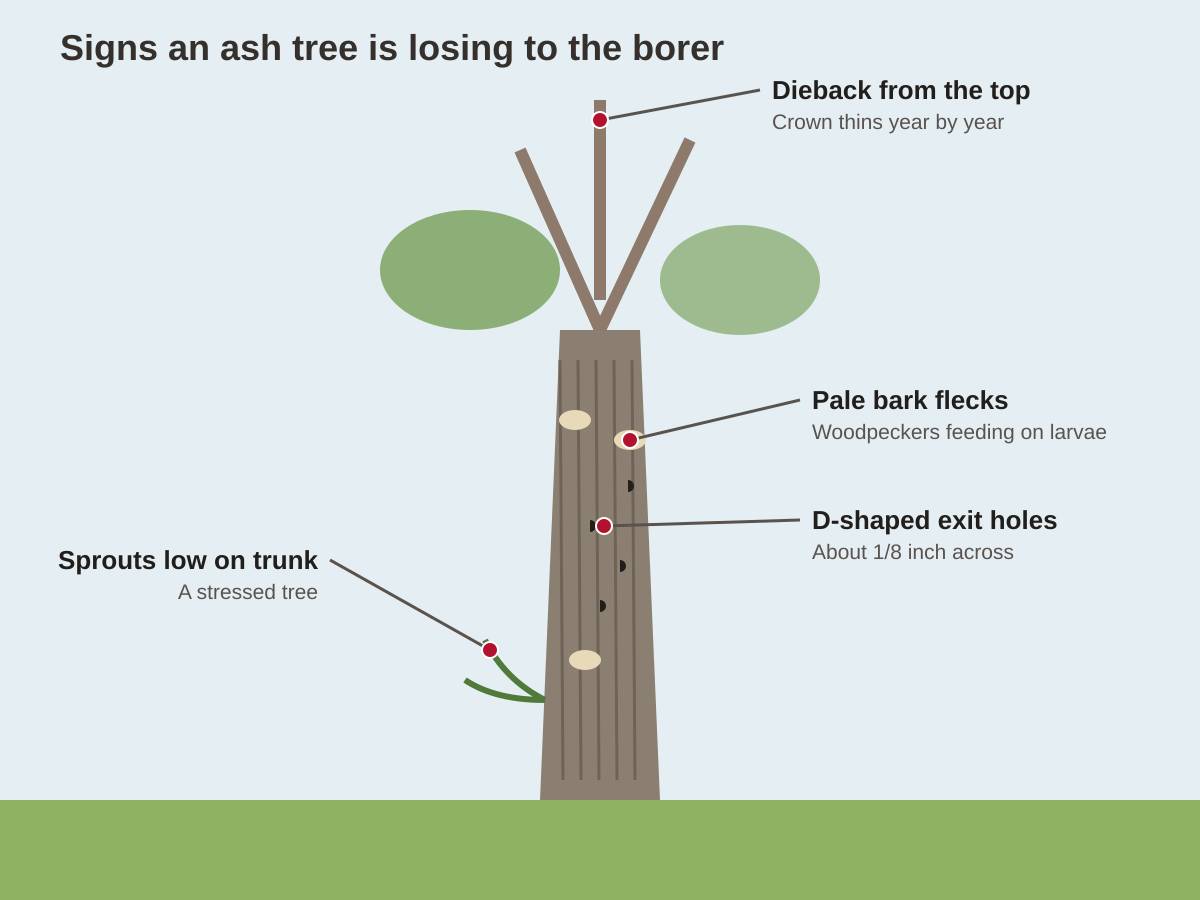
- Thinning from the top. The upper crown gets sparse first, with leaves only on the lower branches.
- Woodpecker damage ("blonding"). Woodpeckers strip patches of outer bark hunting larvae, leaving pale flecks on the trunk.
- D-shaped exit holes. About an eighth of an inch across, where adult beetles chewed out.
- Vertical bark splits over the larval galleries.
- Sprouts low on the trunk or from the roots, as the stressed tree tries to regrow.
By the time you see these signs, the tree has usually been infested for a couple of years.
Treat, watch or remove: a decision chart
| Your ash | Typical answer | Next step |
|---|---|---|
| Healthy crown, tree you value, near the house | Treatment is often worth it | Ask about a systemic insecticide program before symptoms appear |
| Up to about a third of the crown thin or dead | Treatment may still work | Treat soon and re-check the crown next summer |
| Half or more of the crown dead | Removal is usually the realistic choice | Remove while the wood is still safe to climb |
| Dead for more than a year, bark falling off | Remove soon | Brittle wood; may need a lift or crane |
| Ash far from any house, road or path | Monitor or let it go | Low risk; recheck after storms |
The usual guidance is that trees that have already lost a large share of the canopy are poor candidates for treatment. A pro can look at yours and tell you where it stands.
If you treat
Treatments are systemic insecticides, either injected into the trunk or applied to the soil or bark, and they need to be repeated on a schedule for as long as you want to keep the tree. For a large, healthy ash that shades your house, a treatment program can cost less over many years than removing the tree. Applying pesticides for pay requires a Tennessee Department of Agriculture license, so ask to see it.
If you remove
Don't wait too long. Once an ash dies, the wood dries out and becomes brittle quickly, and dead ash is known for breaking unexpectedly. Once a dead ash has stood for a while, climbers may not be able to safely tie into it, which means a bucket truck or crane and a higher price. Dead and hazard tree removal explains how a pro handles it.
What removal costs
Ash trees in Maury County yards range from 30-foot fence-row trees to 70-foot shade trees. Price depends on height, what the tree could hit, and whether the wood is still sound. The cost guide has typical ranges. For a real number, call (931) 414‑6035.
After the ash is gone
- Grind the stump. Ash can sprout from the stump; grinding and mowing handles it. See stump grinding.
- Keep the firewood local. Burn it on your property or nearby.
- Replant with something different. A mix of species protects your yard from the next pest. Oaks, blackgum, tulip poplar and hornbeam are good starting points for Middle Tennessee yards. Avoid Bradford pears; see the Bradford pear guide.
Ash trees near power lines
A dying ash beside a line is a common cause of outages. If your ash could reach the line to the house, the utility needs to be involved before it comes down; read trees near power lines in Columbia, TN.