
Safety first. If the tree is on a wire or you can't tell, treat the wire as live, keep everyone at least a truck's length away, and call your electric provider before anyone touches the tree. See trees near power lines. If you smell gas, leave the house and call the gas company or 911.
The storms that bring trees down here
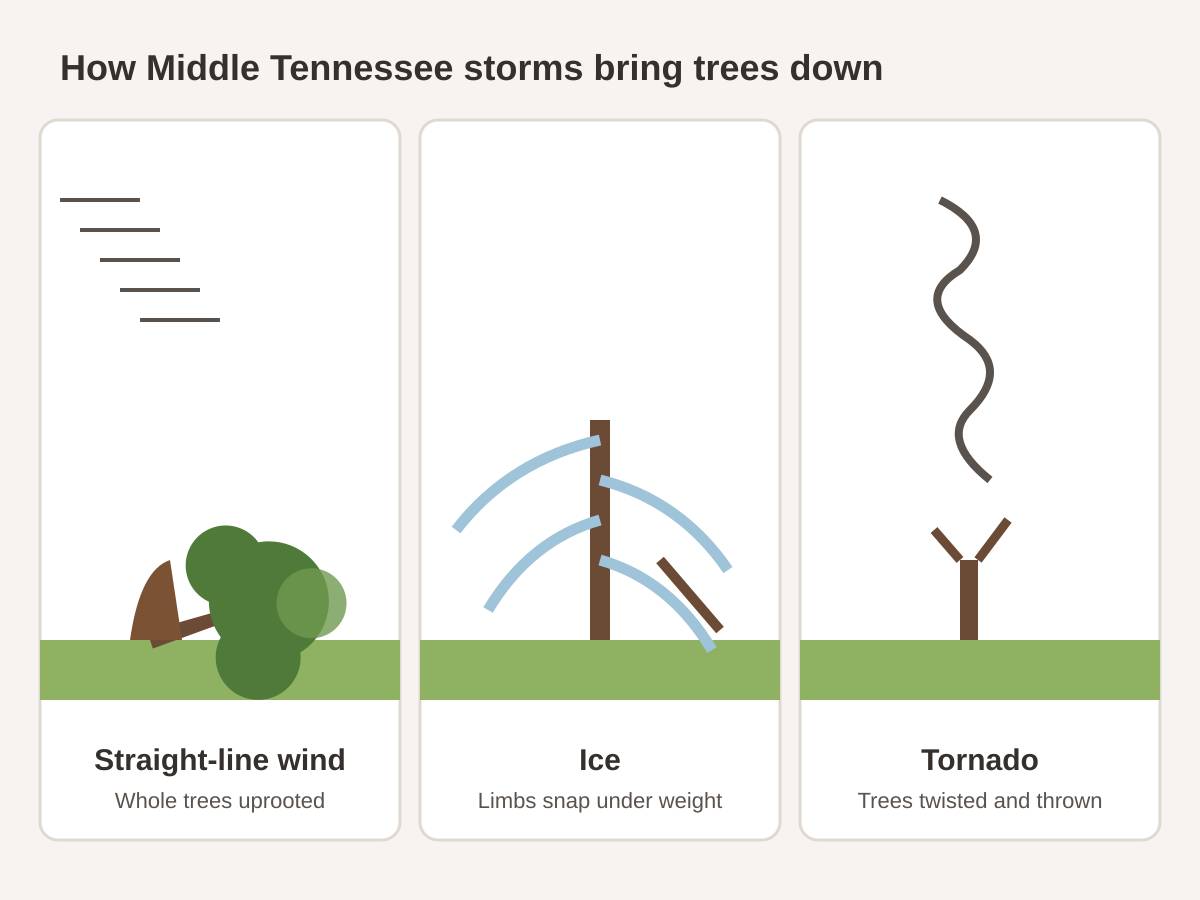
Maury County sits in the middle of the Tennessee Valley's severe-weather belt, and trees fail here in three main ways:
- Straight-line winds. The gust fronts ahead of spring and summer thunderstorms can be strong enough to snap big limbs. On thin, soaked soil over limestone, whole trees tip out of the ground, root plate and all.
- Tornadoes. Maury County has had tornado damage in recent years, with homes hit and bands of trees flattened. In Middle Tennessee, tornadoes can come in late fall and winter as well as spring.
- Ice. Freezing rain loads every twig with ice. Brittle trees such as Bradford pears, silver maples and hackberries shed limbs, and whole crowns can split.
The first hour after a tree falls
- Get people out of danger. Out of any room the tree entered, and out of the house if you see a sagging ceiling or smell gas.
- Stay away from wires. Call the electric utility named on your bill, and 911 if anyone is in danger.
- Photograph everything. The tree, the roof, the inside damage, the fence, the car. Take pictures before anything is moved; insurers ask for them.
- Stop water where it's safe. Move valuables, put out buckets. Don't climb onto the roof.
- Call your insurer to open the claim and ask what they need.
- Call a tree pro. Describe exactly what the tree is resting on and whether it has moved since it fell.
How a pro removes a tree from a house
A tree lying on a roof is still loaded like a spring. Cut the wrong piece and the trunk can shift, roll or drop farther into the house. That is why this is not a job for a borrowed chainsaw:
- Reading the loads. The pro works out which parts of the tree are bearing on the roof and which are hanging free.
- Rigging or crane. Limbs are cut and lowered in controlled pieces. For a big trunk across a roof, a crane may lift sections straight up and away, which often does the least extra damage.
- Leaving the roof ready for the next trade. Once the tree is off, ask the pro whether they can put a tarp over the opening or whether you should line up a roofer.
- Clearing the yard. Brush chipped, trunk cut and hauled or stacked, and the root ball dealt with; a root plate torn out of the ground often leaves a crater that needs backfill.
Trees down but not on anything
Not every storm tree is an emergency. A tree across the back of the yard can wait for a calmer day and a lower price. A few that do need prompt attention:
- A tree blocking your only driveway or a road you need.
- A "hanger": a broken limb caught in the crown above a path, a driveway or a play area.
- A tree that is uprooted partway and leaning on another tree or a fence.
- A split trunk still standing over the house.
Leaning, half-fallen trees are among the most dangerous things in tree work. Don't cut them yourself; the stored tension can release in unpredictable ways.
After the storm: check the trees still standing
Storms leave damage that shows up later. Walk the yard in the days after: look for new leans, soil cracked around the base, torn bark, split forks and hanging limbs. A tree that lost big limbs or half its crown may be worth removing now, before the next storm finishes it. Dead and hazard tree removal covers what to look for, and tree trimming handles broken limbs on trees worth keeping.
Storm debris and burning
After a major storm, ask the city or county whether any curbside debris pickup is planned and how they want limbs stacked. Burning storm debris outdoors needs a free Tennessee Division of Forestry permit during fire season, and cities may prohibit it; check with the Division of Forestry and your city first.
What storm work costs
Storm removals usually cost more than planned removals of the same tree: the work is more dangerous, often needs a crane, and happens when every crew in the county is busy. A tree on the ground in the open may price close to a normal removal; a tree on a roof is quoted on site. The cost guide explains the factors. Before any work starts, get a written price, and be careful with anyone who wants full payment in cash up front.
If your tree is still standing and you are worried about the next storm, start with tree removal in Columbia, TN or ask for a free estimate below.