
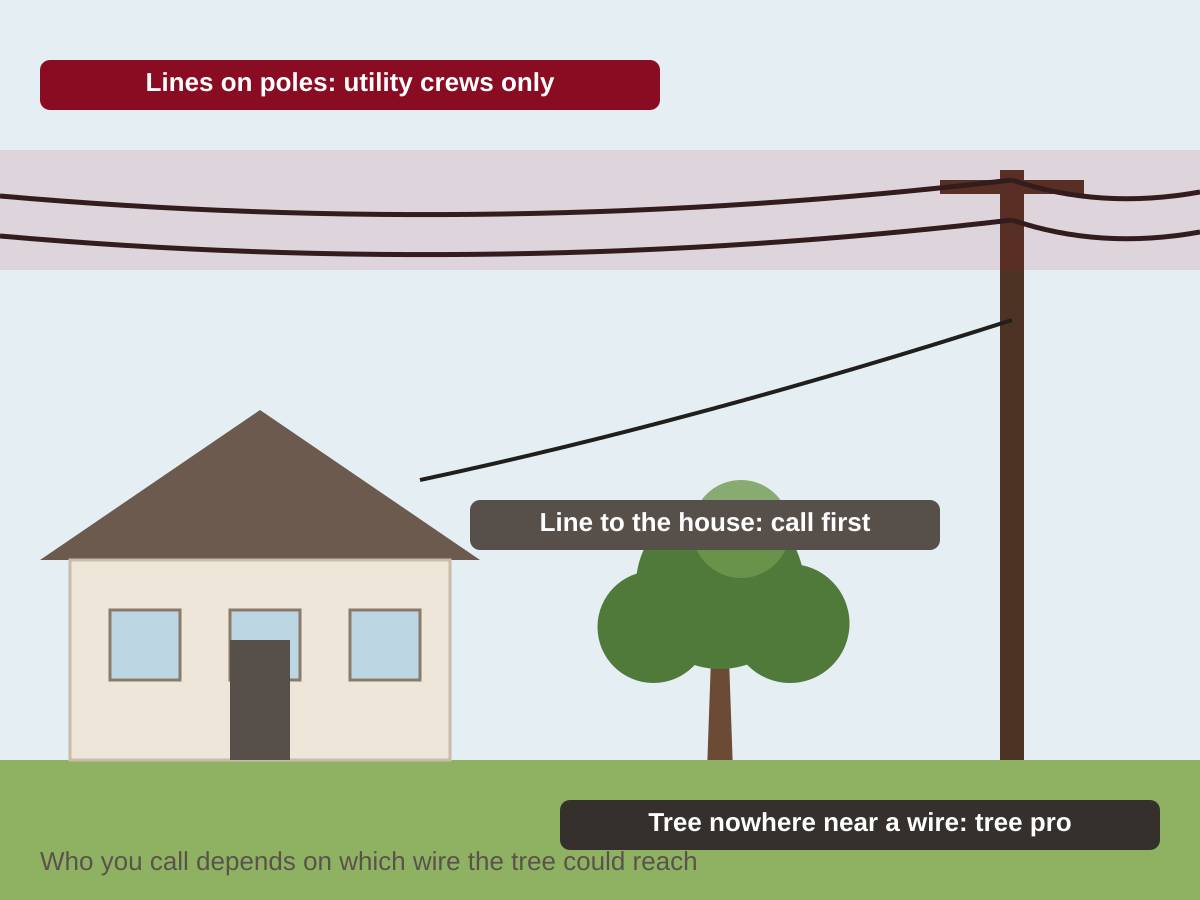
If a tree or limb is touching a line right now: stay back, keep everyone else back, and call your electric utility. If a line is down or sparking, call 911 too. Don't touch the tree, the line, or anything they're touching.
Which utility serves you?
Maury County has more than one electric provider, and the name on your bill tells you who to call:
- Inside the city of Columbia, power usually comes from Columbia Power & Water Systems (CPWS).
- Rural parts of the county are often served by an electric cooperative rather than a city utility.
- Other towns and Spring Hill can be served by different providers, and in Spring Hill it can vary by street.
If you're not sure, the name on your bill settles it.
Three kinds of wire, three different answers
1. Primary lines on poles
These are the high-voltage lines running along roads, alleys and across properties. The utility trims around them to protect service, usually on a regular cycle and often through contract crews. Only the utility or its qualified contractors should work near these lines. If a tree is growing into one, call the utility and ask them to look at it.
2. The service drop to your house
The line running from the pole to your house (the "service drop") carries lower voltage, but it is still dangerous. Utilities handle this line differently; some will temporarily disconnect or drop it so a tree pro can safely remove or trim a tree nearby, and then reconnect it. Ask the tree pro and your utility how it works for your address.
3. Trees clear of any line
If the tree couldn't reach a wire even if it fell the wrong way, it's ordinary tree work. A private tree pro can handle it directly.
Why you shouldn't trim near a line yourself
- Electricity doesn't need direct contact. It can arc across a gap, especially to wet wood and leaves.
- Trees conduct. A branch touching a line can energize the whole tree, the ground around it, and a ladder leaning on it.
- Loaded limbs move. Cutting a limb that rests on a wire can release it suddenly, snapping the wire or swinging the limb into you.
- The rules require training. Federal safety rules limit work near energized lines to specially trained line-clearance workers.
After a storm
Tornadoes, spring squall lines and winter ice bring trees down on lines across the county. Utilities restore main lines first, then work outward toward individual homes. Meanwhile:
- Treat every downed line as live. Stay well away and keep kids and pets inside.
- Report the outage and any downed lines to your utility.
- Don't have a tree crew start on a tree tangled in wires until the utility says the line is dead or clear.
- If the tree also hit your house, see storm and emergency tree removal.
Damage to the equipment on your house where the service line connects (the weatherhead and meter base) is often the homeowner's to repair, usually by an electrician, before the utility will reconnect. Check with your utility.
Planting near lines
The best way to avoid future trouble is to plant right. Keep tall-growing trees well away from overhead lines, and choose small trees, like redbud or serviceberry, if you plant anywhere near them. Many utilities publish "right tree, right place" planting guides, so ask yours. The Bradford pear guide has a list of native small trees.
Before any tree work near a line
- Tell the tree pro exactly where the lines are when you ask for an estimate.
- Ask how they'll coordinate with the utility and who is calling whom.
- Expect scheduling to depend partly on the utility's availability.
- Keep your own distance on the day of the work.
Need a tree near a line removed or trimmed? Call (931) 414‑6035 and we'll connect you with an experienced local pro who can coordinate with your utility. More on tree removal in Columbia, TN, tree trimming and dead and hazard trees.