
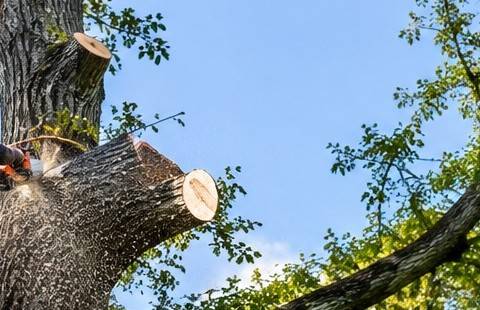
What counts as a hazard tree?
Arborists judge risk by two things together: how likely the tree or a big part of it is to fail, and what it would land on. A dead cedar at the back of a pasture in Santa Fe is a small risk even though it will certainly fall. A living silver maple with a cracked fork above a child's bedroom in a Spring Hill subdivision is a big one.
So before you look up at the tree, look around it. Estimate how tall it is and note everything within that distance of the trunk: the house, the driveway, the carport, the swing set, the neighbor's fence, the street and any overhead line. Those "targets" decide how urgent everything below is.
Warning signs, from the ground up
Roots and soil
- Soil cracked or lifting on one side of the trunk, sometimes with the grass raised like a lid. The root plate is moving.
- Mushrooms or shelf-shaped conks on the root flare. Wood-decay fungi are eating the roots or the base.
- Roots severed in the last few years for a driveway, a sewer tap, a fence or an addition. Trees on thin soil over limestone depend on those wide, shallow roots, and losing them on one side can make a tree unstable.
Trunk
- Cracks or seams running up the trunk, or opening where two stems meet.
- Cavities and hollow sounds when you knock with a rubber mallet.
- Bark sloughing off in plates, or vertical splits in the bark of an ash.
- A lean that is new, especially after days of rain. An old, stable lean with a top that has curved back upward is less worrying.
Crown
- Dead limbs with no leaves in summer, or broken limbs hung up in the crown ("hangers").
- A thin, patchy top on an ash, with leaves only on the lower branches.
- Tight, upright forks with bark pinched between them, the weak point on Bradford pears and many maples.
Emerald ash borer: the biggest source of dead trees here
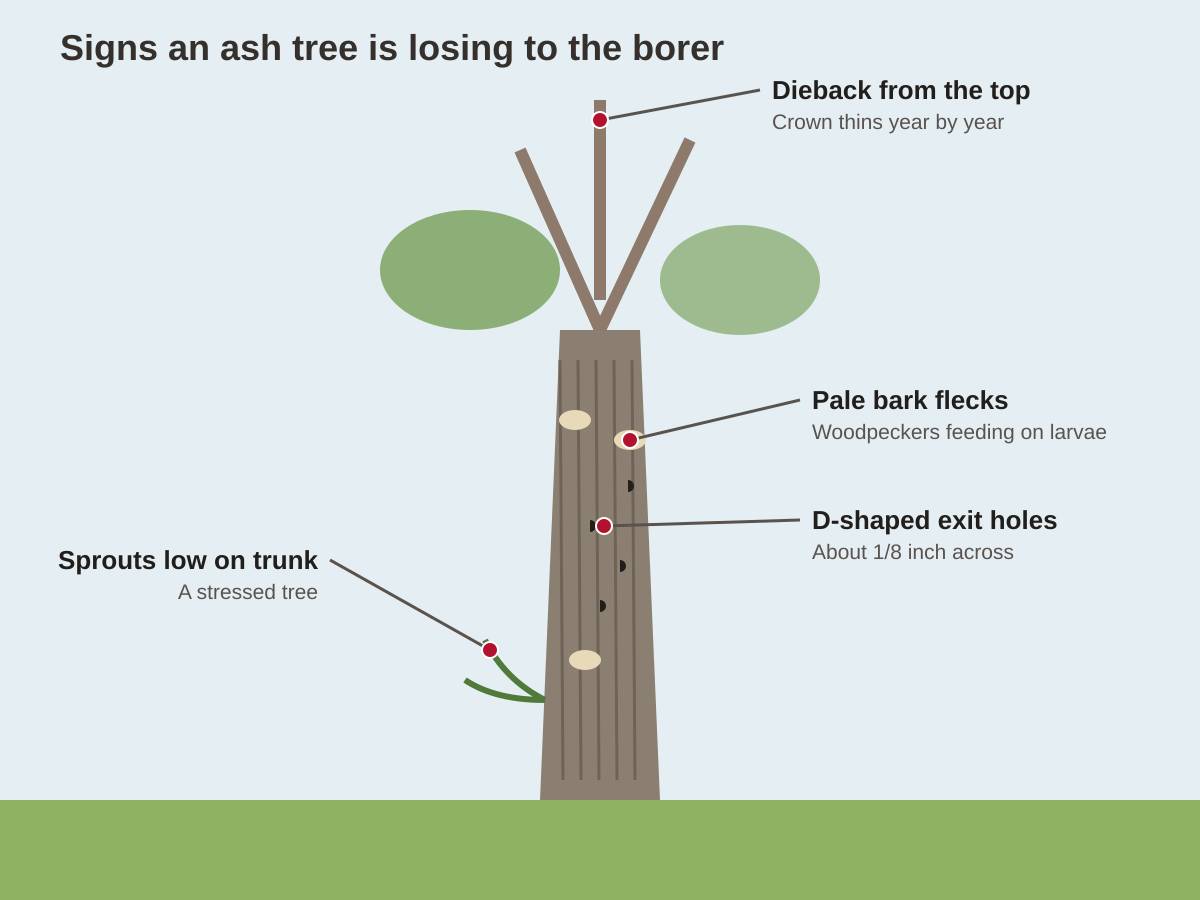
Emerald ash borer has spread across Middle Tennessee, working through the ash trees in yards, along creeks and in woodlots. Its larvae tunnel under the bark and cut off the tree's water supply. Infested trees thin from the top down, sprout shoots low on the trunk, and show pale patches where woodpeckers have stripped bark hunting larvae. The adult beetles leave small D-shaped exit holes.
What makes ash dangerous after death is how quickly the wood fails. Dead ash dries out and becomes brittle, and trees killed by the borer are known for snapping unpredictably, which makes climbing them risky. That is why a dead ash near a house is best removed soon, while a climber can still work in it, rather than after a few more seasons. If your ash is still mostly green, read the emerald ash borer guide before deciding; some trees can still be protected.
Other common hazard trees in Maury County
Hackberries
Hackberries grow fast and are common in older Columbia yards and along fence rows. As they age they are prone to internal decay and to dropping heavy limbs, often with little warning from the crown. Look for fungus on the trunk, cavities and dead limbs.
Bradford and Callery pears
By 20 or 25 years old, most Bradford pears have a crown full of tight forks that split in wind or ice. A pear that has already lost a big section usually keeps splitting. The Bradford pear guide explains when to keep one and when to take it down.
Silver maples and old sugar maples
Silver maples grow fast, root shallow and have brittle wood. Sugar maples are sturdier but big old ones often carry decay in the trunk from past pruning wounds.
Cedars and trees on thin soil
Eastern red cedars and other trees on rocky ground can tip whole after heavy rain because their roots have nowhere to go but sideways. A cedar leaning toward a driveway or outbuilding deserves a look.
How a pro takes down a dead or damaged tree
Removing a hazard tree is slower and more careful than a routine removal:
- Assessing the wood. The pro checks whether the tree is sound enough to climb and tie ropes into. If not, they plan the job from a bucket truck or with a crane.
- Clearing the drop zone. Cars moved, people and pets inside, and the area under the tree cleared.
- Taking it apart in pieces. Dead limbs first, then the crown, then the trunk in sections, each lowered with rigging where there is anything to protect.
- Handling the wires. If the tree could reach the line to the house, the pro arranges with the utility before cutting. Never cut near a line yourself; see trees near power lines.
- Cleanup and the stump. Chipping, hauling, and stump grinding if you want it.
Ash wood from a borer-killed tree can generally be kept as firewood on your property. Moving firewood long distances spreads forest pests, so buy and burn it locally.
How urgent is it?
- Call now if the tree is actively leaning more, cracking, lifting at the roots, or has a large broken limb hanging over a house, driveway or play area. Keep people out of its reach and call (931) 414‑6035.
- Within weeks for a dead ash or any dead tree within reach of a building, especially before spring storm season.
- Plan ahead for trees with slow decline in open areas. Photograph them from the same spots each season.
Questions to ask before you hire
- Is the tree safe to climb, or does it need a lift or crane?
- What happens to the wood, brush and stump, and are they in the price?
- How will you protect the lawn, driveway and septic system from heavy equipment?
- Do your liability and workers' comp policies cover climbing and felling work, and can I see the certificates? Check any credential you rely on yourself.
- If the tree is in a historic district or an HOA, who handles the approval?
For the storm-damaged version of this problem, see storm and emergency tree removal. For live trees that just need dead wood taken out, see tree trimming. And for a general overview, start at tree removal in Columbia, TN.