
Why trim a tree at all?
- Safety. Dead and broken limbs are the first thing to fall in a spring thunderstorm. Removing them is the single most useful pruning most mature trees need.
- Clearance. Limbs over the roof shed twigs and leaves onto it, rub shingles and give squirrels a highway into the attic. Limbs over the driveway scrape trucks.
- Structure. Young trees trained early grow into strong adults. Weak forks on older trees can be reduced so they carry less weight.
- Light and air. Thinning a dense crown lets light reach the lawn and lets wind pass through instead of pushing the whole tree.
Common kinds of pruning
Deadwood removal (cleaning)
Taking out dead, dying and broken branches throughout the crown. On a big oak or sugar maple this is often all the tree needs, every few years.
Raising
Removing lower limbs to clear the roof, the driveway, the sidewalk or a view. Done in stages on large trees, so the trunk isn't left with a few big wounds at once.
Reduction
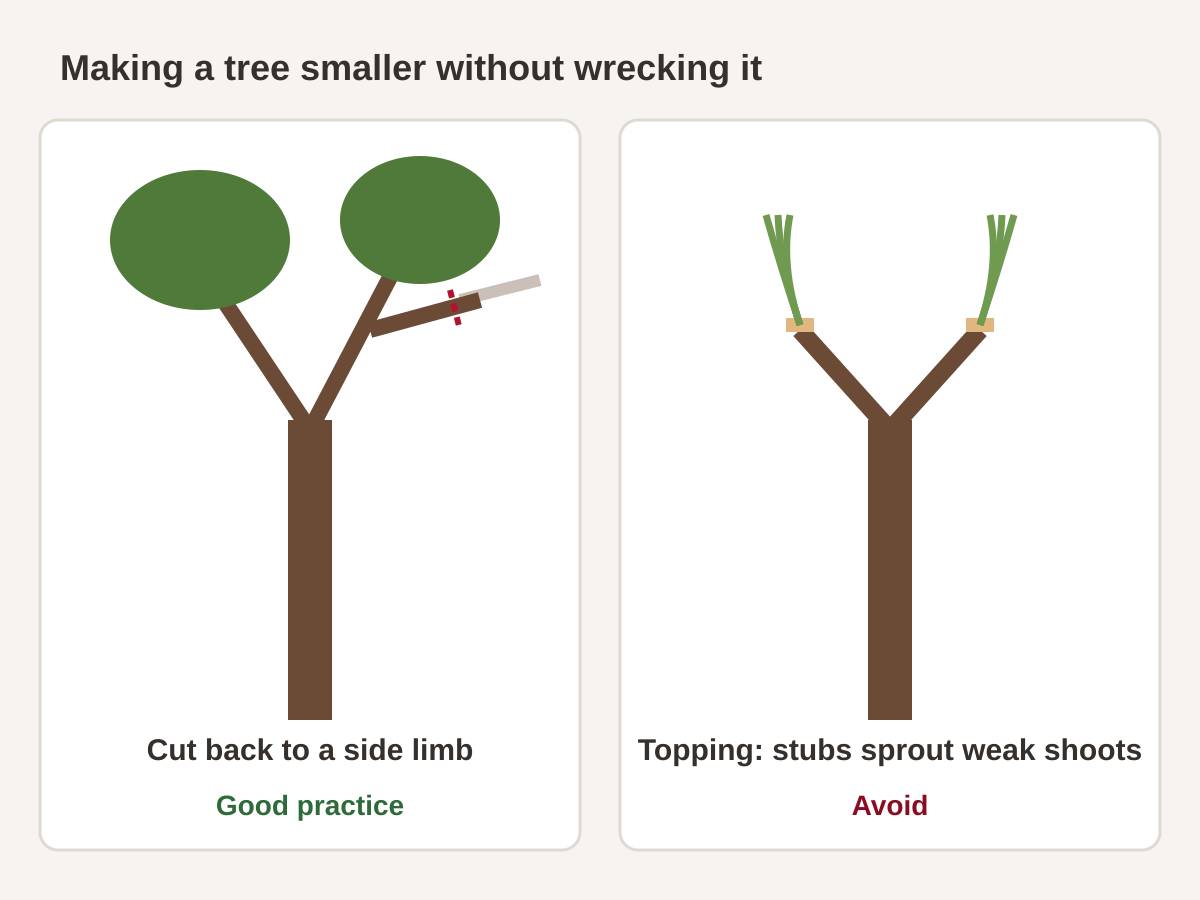
Shortening long limbs or lowering the height by cutting back to a side branch at least a third the size of the one removed. It is the proper alternative to topping when a tree has outgrown its space.
Thinning
Selectively removing smaller branches to open up a dense crown. Good thinning is subtle: the tree looks lighter, not butchered.
Structural pruning of young trees
For the new trees planted in Spring Hill subdivisions and around new homes, a few careful cuts in the first ten years, choosing one main leader and spacing the main limbs, prevent the weak forks that later split.
Good cuts and bad cuts
Where a limb is cut matters as much as which limb. A proper cut is made just outside the branch collar, the slightly swollen ring where a branch joins the trunk, so the tree can seal the wound. Flush cuts that shave the collar off, and stubs left sticking out, both invite decay.
Topping, where limbs are cut back to stubs to shrink a tree, is the most damaging practice of all. It is still offered by some crews, especially after storms. The regrowth is a thicket of weakly attached shoots that break easily, and the stubs rot back into the trunk. If a quote says "top" or "hat-rack", get another quote.
Professional pruning in the US generally follows the ANSI A300 standard, and a good pro should be comfortable explaining what they plan to cut and why.
Trees that come up most around Columbia
White and red oaks
Long-lived and worth caring for. Mostly deadwood removal and clearance. Timing matters because of oak wilt: many arborists avoid pruning oaks in spring and early summer.
Sugar and silver maples
Sugar maples respond well to light thinning and deadwood removal. Silver maples grow fast and form weak forks; regular reduction can keep them safer near houses, though a silver maple crowding a roof is often a candidate for removal.
Hackberries
Frequently need deadwood removal and clearance. Large pruning wounds on hackberries decay readily, so smaller, more frequent cuts are better than a heavy one-time job.
Bradford pears
Reduction pruning can lighten the load on weak forks, but it does not fix the underlying structure. See the Bradford pear guide.
Ash
Pruning won't save an ash from emerald ash borer, and climbing a declining ash gets riskier every year. Decide on treatment or removal first; the ash borer guide helps.
Branches near wires
Limbs growing into the lines on poles are the utility's job, handled on its own trimming cycle. The line from the pole to your house is different: the utility may need to disconnect it before a tree pro trims near it. Never prune near any power line yourself, even with a pole saw. Read trees near power lines in Columbia, TN.
When trimming isn't enough
A good pro will tell you when a tree has more problems than pruning can solve: major trunk decay, a split fork, a dead or dying ash, a tree leaning further each year on shallow roots. In those cases, see dead and hazard tree removal or start at tree removal in Columbia, TN.
What trimming costs
Pruning is priced by the tree and the time it takes: height, how much wood comes out, whether it has to be roped down over a roof, access for a bucket truck, and cleanup. Doing several trees in one visit usually lowers the per-tree price. The cost guide has typical ranges.
Questions to ask a pruning pro
- What exactly will you remove, and roughly what percentage of the crown?
- Will you use climbing spikes? (They shouldn't be used on trees that are staying.)
- Do you follow ANSI A300 pruning practices?
- Is cleanup and hauling included?
- What liability and workers' comp coverage do you carry for pruning work? Check any credential you rely on yourself.